Carrier Code 44 in Santa Clarita
Quick take: A Carrier code 44 in Santa Clarita, CA (ZIP 91350 to 91390) means the Infinity control sees an excessive air-delivery restriction, almost always a clogged filter, a dirty coil, closed dampers, or collapsed attic flex duct, so call (213) 566-7218 or book online. We measure static pressure, then clear the real restriction instead of guessing.
Quick reference
- Code 44 = excessive air-delivery restriction; the system cannot move enough air through the coil and ducts.
- Top Santa Clarita triggers: dust-clogged filter, dirty evaporator coil, undersized return, collapsed attic flex.
- We confirm it by measuring total external static pressure across the air handler, not by eye.
- Ignored, a 44 ices the coil in summer and trips furnace limit codes 13 and 33 in winter.
- Fix lanes: filter a few dollars, coil clean $150-$400, duct work $400-$3,100, ECM blower $450-$2,300.
- Serving Valencia, Saugus, Canyon Country, Newhall, Stevenson Ranch-adjacent, and Tesoro del Valle, 91350 to 91390.
What does a Carrier code 44 actually mean?
Code 44 is the Infinity control's air-delivery restriction alarm. The board on the furnace or air handler knows how hard the variable-speed ECM blower is working to hit its airflow target. When the motor has to push past a set threshold to deliver the air the system commanded, the control concludes the path is restricted and logs a 44 instead of letting the equipment cook itself. Think of it as the system taking its own pulse and finding the pressure too high. The restriction can sit anywhere in the air path: the filter, the evaporator coil, the supply and return ducts, the dampers on a zoned system, or the blower itself. The code names the symptom, not the location, which is exactly why a static-pressure reading matters more than a guess.
Why does my Carrier throw a 44 in Santa Clarita homes?
This valley produces 44s for reasons the coast does not. Santa Clarita sits in Title-24 Climate Zone 9 above the LA basin, with hotter, drier summers and the dust that rides Santa Ana winds, so filters here clog faster than a maintenance schedule expects. That alone is the single most common 44 we clear. The second driver is the housing stock: master-planned Mediterranean and Spanish-tract two-story production homes across Valencia, Saugus, and Tesoro del Valle run their supply and return flex duct through attics that reach 130 to 150F in July. That flex sags off its hangers, kinks at tight turns, and slowly pulls apart at the boots, all of which strangles airflow and trips a 44 even when the filter is spotless. Older Newhall ranch and bungalow homes add a third twist: undersized original returns and decades of remodel-era duct splices that were never sized for a modern high-static coil. Zoned Infinity systems add a fourth, where a stuck or mis-set damper closes off too much of the home and starves the blower. The code is the same number across all of these; the cause is wildly different, and so is the bill.
How do you diagnose a Carrier code 44?
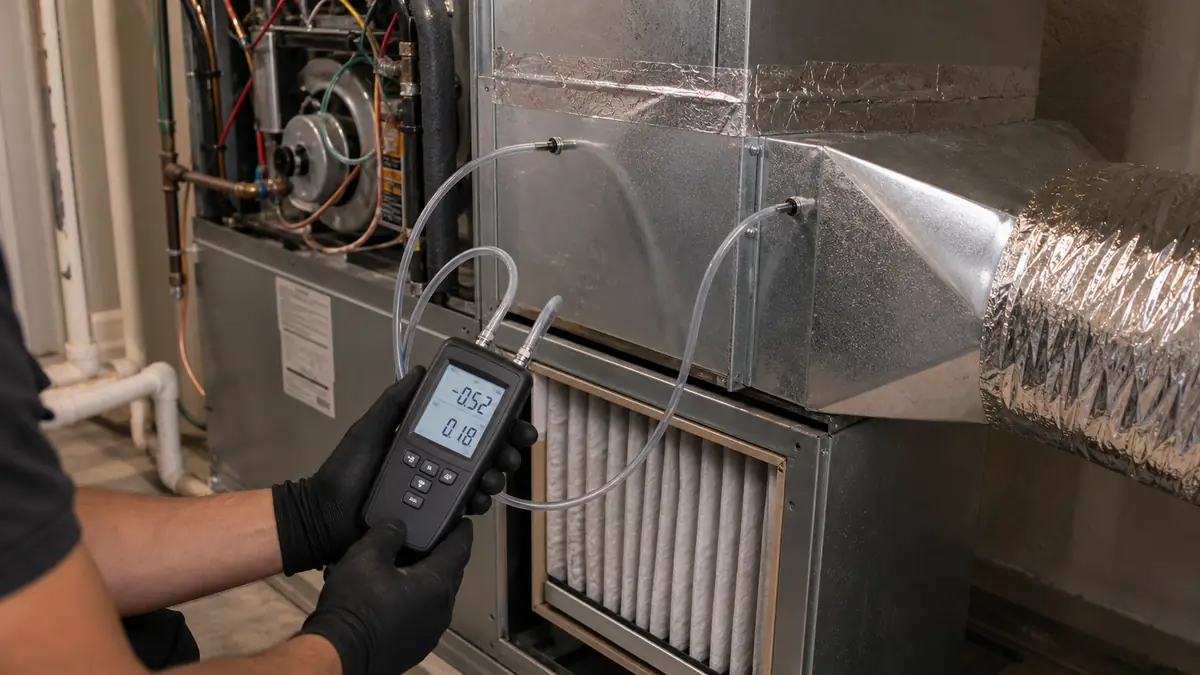
We work the air path in order, cheapest first, with readings at each step. First we pull and inspect the filter and read the model and tonnage so we know the target airflow. Then we connect a manometer and measure total external static pressure across the air handler in inches of water column; a healthy residential system runs near 0.5, and a 44 system is usually well above 0.8, sometimes past 1.0. That number alone confirms the restriction is real and tells us how severe it is. Next we localize: we measure static on the return side and the supply side separately to see which half is choked, then inspect the evaporator coil for the dust-and-pet-hair mat that valley homes grow, and we go into the attic to check the flex for sags, kinks, crushed sections, and pulled boots. On a zoned system we verify each damper opens fully and that the bypass, if any, is set right. We also read live blower RPM and watts from the Infinity service screen to see how hard the ECM is straining. By the time we are done, we can point at the exact restriction and show you the static-pressure numbers that prove it, rather than asking you to take our word.
What can I safely check before calling a pro?
There is a real homeowner half to a 44, and it is worth doing first. Turn the system off, pull the filter, and hold it to the light: if you cannot see through it, replace it with the correct size and a MERV in the 8 to 11 range, not a dense MERV 13 that can itself cause a 44 on an older system. Confirm every supply register in the house is open and not blocked by furniture or a rug, and check that the return grille is clear; people often close upstairs vents in winter and forget. Walk the accessible attic flex if you can do it safely and look for an obviously crushed or disconnected duct. Then run a cooling cycle and see if the 44 clears from the fault history. That is the safe boundary. Do not open the blower compartment, do not pull the coil, and do not start adjusting ECM settings or dampers; static pressure, coil access, and motor testing are pro territory because the readings require instruments and the parts carry real cost. If a clean filter and open vents do not clear the code, stop there and call (213) 566-7218.
What does it cost to fix a Carrier 44 in Santa Clarita, and when is it urgent?
Cost tracks the cause, and the spread is wide. A filter is a few dollars and a five-minute job. A deep evaporator-coil cleaning runs roughly $150 to $400 depending on access. Duct work is the big lane: sealing leaky attic runs, re-hanging sagged flex, or adding and resizing a starved return in a 2,000 square foot valley two-story lands anywhere from $400 to $3,100, with full duct replacement climbing higher. If the restriction turns out to be a failed ECM blower motor or its module, that is $450 to $2,300, since the variable-speed module on a Carrier air handler is a genuine part. On urgency: a 44 is rarely a same-minute emergency, but it is not something to run for weeks. Ignored through a 100F-plus Santa Ana stretch it will ice the coil and can leave you with no cooling on the hottest day, and through winter the same starvation overheats the heat exchanger and trips limit codes 13 and 33. If the system is icing, short-cycling, or you have lost cooling entirely during a heat spike, treat it as urgent and call (213) 566-7218; we hold same-week and emergency slots for Santa Clarita. For the broader symptom picture see our weak airflow page, the attic side on our duct repair page, and the full code list on the Carrier error codes hub.
Common questions about Carrier code 44
What does code 44 mean on my Carrier?
Code 44 means excessive air-delivery restriction: the Infinity control measured that it cannot move enough air through the coil and ducts. The usual triggers are a clogged filter, a dirty evaporator coil, closed or undersized dampers, or collapsed flex duct in the attic. Clear the restriction and the code clears. If it returns after a clean filter, call (213) 566-7218 for a static-pressure check.
Can I fix a Carrier 44 code myself?
Sometimes. Swap a clogged filter for the correct size and MERV, confirm every supply register and the return grille are open, and run a cooling cycle to see if the code clears. That is the safe homeowner half. If a clean filter and open vents do not clear it, the restriction is in the coil, the ducts, or the blower, and that needs instruments and is a pro job.
Will a code 44 damage my Carrier system?
Left alone, yes. Starved airflow lets the evaporator coil ice over in summer and drives up head pressure, which strains the compressor, and in winter the same restriction trips furnace limit codes 13 and 33 from an overheating heat exchanger. The code itself is protective; the damage comes from ignoring it and forcing the system to run restricted for weeks.
How much does fixing a Carrier 44 cost in Santa Clarita?
It depends entirely on where the restriction is. A filter is a few dollars, a deep coil cleaning runs about $150 to $400, and sealing or re-hanging leaky attic flex duct lands roughly $400 to $3,100. If the cause is a failed ECM blower motor or module it is $450 to $2,300. Call (213) 566-7218 and we confirm the lane before quoting.