Smart Thermostat Installation in Santa Clarita
Quick take: Santa Clarita Carrier HVAC installs and wires smart thermostats across Santa Clarita, CA, from Valencia (91355) to Canyon Country (91387). We set up the Carrier Infinity System Control over ABCD wiring and add C-wires, then call (213) 566-7218 or book online for a $200-to-$900 install.
Quick reference
- Installs the Carrier Infinity System Control (SYSTXCCITC01) for Greenspeed variable-speed systems.
- Wires the ABCD four-wire communicating bus and fixes 178/179 comm faults.
- Adds C-wires to older Newhall and Saugus homes for reliable smart-thermostat power.
- Sets up Carrier Cor and compatible standard smart thermostats on single-stage units.
- Thermostat installs typically run $200-$900 depending on wiring and control tier.
- Serving Valencia, Canyon Country, Saugus, Newhall, Tesoro del Valle, Stevenson Ranch-adjacent.
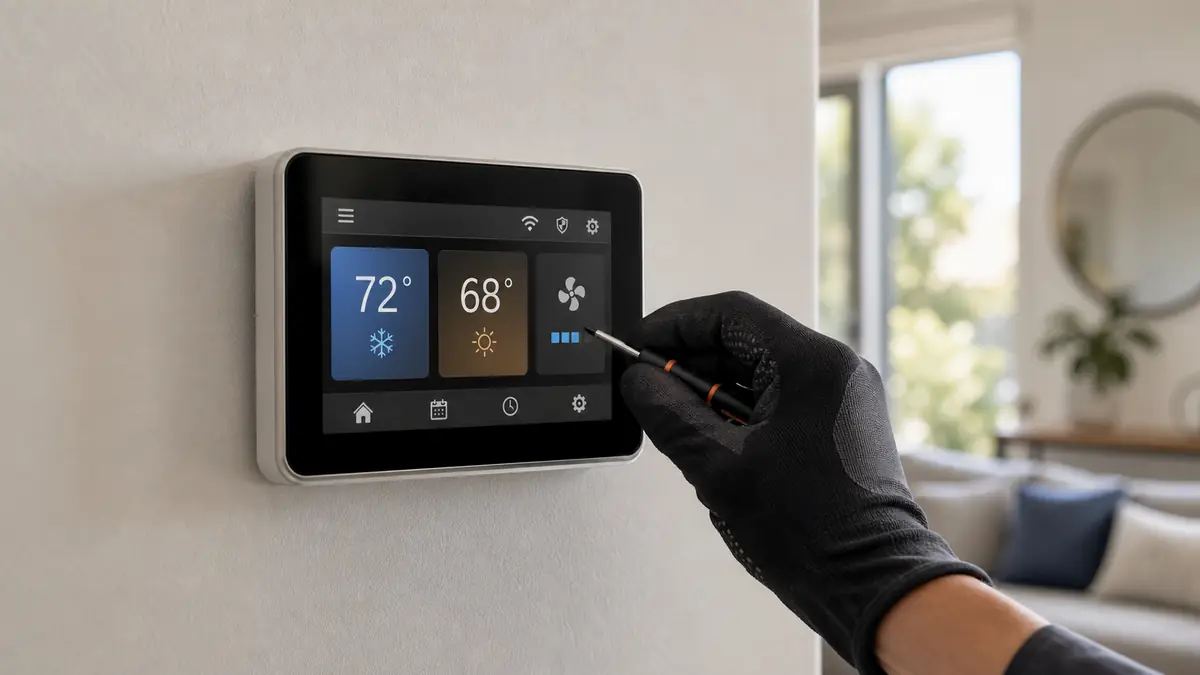
Which thermostat does my Carrier system need?
This is the question that saves valley homeowners from buying the wrong thermostat. A communicating Carrier Infinity Greenspeed system, the variable-speed 24VNA/25VNA/26VNA-class equipment, requires the Infinity System Control because it drives compressor modulation over the proprietary ABCD bus. A generic Nest or Ecobee cannot do that and will lock the system into single-speed, killing the efficiency you paid for. A single-stage Comfort 26SCA or a basic Performance unit, on the other hand, runs fine on a standard 24 V smart thermostat. We identify your equipment first, then match the control.
| System type | Correct control / wiring | Cost lane |
|---|---|---|
| Infinity Greenspeed variable-speed | Infinity System Control (SYSTXCCITC01) over ABCD bus | $400-$900 |
| Performance two-stage (non-communicating) | Two-stage smart thermostat with C-wire | $250-$600 |
| Performance 27VPA9 variable (InteliSense) | Carrier-compatible control matched to the unit | $300-$700 |
| Comfort single-stage | Standard Wi-Fi smart thermostat or Carrier Cor | $200-$450 |
| Older home, no common wire | Add C-wire conductor, then smart stat | $250-$600 |
| Post-swap fault, screen reads 178 / 179 | Re-land ABCD bus; meter comm and line voltage | $150-$400 |
What causes Infinity communication faults after a swap?
If your touchscreen reads 178 or 179 after a do-it-yourself swap, the wiring is almost always the issue. The Infinity control needs the four-conductor ABCD communicating cable landed correctly; people often reuse old thermostat wire or transpose the conductors, and the system cannot talk. We meter the bus voltage and correct the landings. While we are there we confirm the control sees both the indoor and outdoor boards, since the same fault appears when a rodent has nicked the outdoor comm wire, a frequent issue in Canyon Country side yards.
Which Carrier controls match which systems?
Carrier's control families do not mix freely with the equipment, which is the root of most "my new thermostat broke the AC" calls. Here is what fits what:
- Infinity System Control (SYSTXCCITC01). The communicating color touchscreen required to unlock Greenspeed variable-speed modulation on 24VNA, 25VNA, 26VNA, and 27VNA equipment. It talks over the proprietary four-wire ABCD bus and surfaces numeric plus plain-language fault codes. Nothing else drives full modulation.
- Carrier Cor and Performance Edge thermostats. Non-communicating smart and programmable controls for single-stage Comfort and basic Performance systems. These run on conventional 24 V wiring with a C-wire.
- Generic Wi-Fi stats (Nest, Ecobee, Honeywell). Fine on single-stage Comfort 26SCA and basic units; they cannot drive a fully communicating Infinity system and will lock it to single-speed.
- Two-stage smart thermostats. Needed to use both stages of a Performance 26TPA8 two-stage unit; a single-stage stat leaves the second stage stranded.
How does a thermostat install go, step by step?
A clean install is mostly about getting the wiring and the system match right before anything powers up:
- Identify the equipment. We read the condenser and air-handler model numbers to confirm whether you have a communicating Infinity system or a conventional one, which decides the control.
- Check the existing wiring. Count the conductors at the wall plate and the furnace board. Many older Newhall and Saugus homes have only four wires and no C-wire, and an Infinity system needs the dedicated ABCD communicating cable.
- Run or repurpose a conductor. Add a C-wire for steady smart-stat power, or pull proper communicating cable for an Infinity control, rather than relying on power-stealing that causes random reboots.
- Land and configure. Terminate the wires correctly (A-B-C-D on Infinity), set the equipment type and staging in the control, and pair Wi-Fi.
- Verify operation. Confirm a heat call, a cool call, and that the control sees both the indoor and outdoor boards with no 178/179 fault, then walk you through scheduling.
What does a thermostat install cost in Santa Clarita?
Most installs run $200 to $900, with the wiring and control tier driving the price:
- Standard smart stat on a single-stage system: $200 to $450. Straight swap with an existing C-wire.
- Add a C-wire first: $250 to $600. Common in older homes that were wired for a basic heat-cool stat.
- Two-stage control on a Performance unit: $250 to $600. Matching the stat to the unit's staging.
- Infinity System Control on a Greenspeed system: $400 to $900. The communicating control plus proper ABCD wiring.
- Comm-fault repair after a bad swap: $150 to $400. Re-landing the bus and clearing 178/179.
How does a smart thermostat help in the valley heat?
Santa Clarita's afternoon peak is brutal, so pre-cooling the house in the late morning and easing off when everyone is out trims runtime during the hottest, most expensive hours. Scheduling and geofencing handle that automatically. On an Infinity system the bigger payoff is visibility: the control surfaces fault codes like 44 (airflow restriction) and sensor faults before they become a no-cool call, so you can book a fix on your schedule instead of during a heat wave.
Common questions about smart thermostat installation
Can I put a Nest or Ecobee on my Carrier Infinity system in Valencia?
Not on a fully communicating Infinity Greenspeed system. The Infinity System Control talks to the equipment over a proprietary ABCD four-wire bus, and a generic Wi-Fi thermostat cannot drive variable-speed staging. On a single-stage Comfort unit, a standard smart thermostat works fine. We confirm which system you have before recommending a control.
Why does my Infinity touchscreen say communication fault after a thermostat swap?
Codes 178 and 179 mean the control lost its conversation with the indoor or outdoor board. After a swap it is almost always an ABCD wiring mistake: a swapped wire, a loose terminal, or only running thermostat wire instead of the required communicating cable. We meter the bus and correct the landing so the system talks again.
Is a smart thermostat worth it for a Santa Clarita home?
For a high-cooling-load valley, yes. Scheduling and remote control let you pre-cool before the afternoon peak and back off when nobody is home, which matters on 100 F days. The bigger gain on an Infinity system is the diagnostics: it surfaces fault codes and airflow restriction warnings before a breakdown.
Do you wire a C-wire if my older home does not have one?
Yes. Many older Newhall and Saugus homes were wired for a simple heat-cool stat with no common wire. We run or repurpose a conductor for the C-wire so a modern smart thermostat has steady power, rather than relying on power-stealing that causes random reboots.
Can one Infinity control run two zones in my Valencia two-story?
Yes, a Carrier Infinity zoning setup can drive multiple zones with dampers and a zone board, which is a strong fit for a two-story where upstairs runs hot. It needs the communicating Greenspeed equipment and proper damper wiring, so we assess the duct layout before quoting a zoned configuration.
Will a smart thermostat work during a Santa Clarita power flicker?
A properly C-wired smart thermostat rides through brief flickers and reconnects to Wi-Fi on its own. Power-stealing setups without a C-wire are the ones that reboot or drop offline during the brownouts that hit the valley on peak heat days, which is one more reason we insist on a real common wire.