Carrier AC Making Noise in Santa Clarita
Quick take: A noisy Carrier AC in Santa Clarita, CA, points to a specific part by its sound. Santa Clarita Carrier HVAC decodes buzzing capacitors, screeching fan motors, and rattling inducers on 26-series and 59-series units, so call (213) 566-7218 or book online for a same-week Canyon Country (91387) diagnosis.
Quick reference
- Buzz with stalled fan: failed capacitor or contactor ($150-$450), the top SoCal heat failure.
- Repeated clicking: chattering contactor or relay; Infinity may show code 73.
- Screech or grind: condenser fan motor bearing or rubbing blower wheel.
- Rattle or drone at the furnace: inducer motor, often with pressure-switch code 31.
- Hard bang on shutdown: refrigerant slugging or loose compressor mount.
- Serving Canyon Country, Newhall, Valencia, Saugus, Tesoro del Valle, Stevenson Ranch-adjacent.
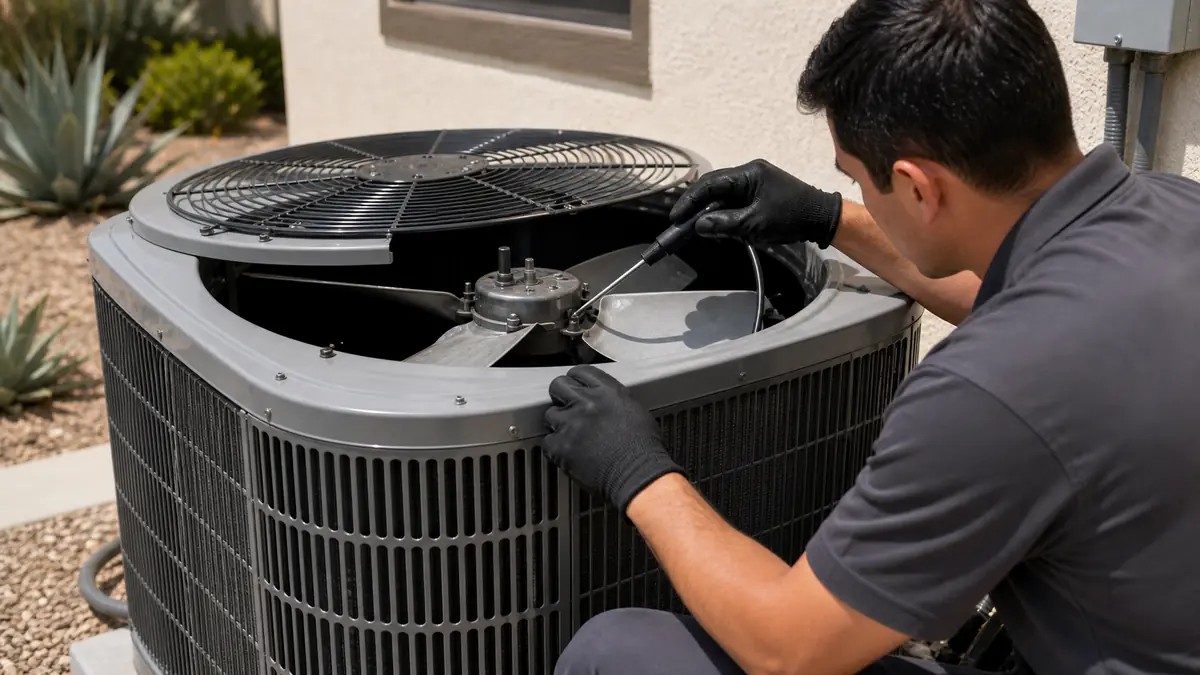
What does each Carrier AC noise mean?
HVAC noises are diagnostic clues, and matching the sound to the part saves time and money. In the Santa Clarita Valley, the heat drives a predictable set: electrical buzzing and clicking from capacitors and contactors that cook in the summer, mechanical screeches from fan-motor bearings worn by dust and heat, and refrigerant or combustion sounds from the system internals. Below is the sound-to-cause map. A new or sudden loud noise plus a shutdown means turn the system off and call, so a small failure does not cascade into a compressor.
| Noise | Likely cause / first check | Cost lane |
|---|---|---|
| Loud electrical buzz, fan stalled | Failed dual-run capacitor or contactor | $150-$450 |
| Repeated clicking, won't start | Chattering contactor or relay; Infinity code 73 | $150-$450 |
| Metallic screech or grind outdoors | Condenser fan motor bearing or blade rub | $250-$700 |
| Rattle or drone at the furnace | Inducer motor; check pressure-switch code 31 | $200-$700 |
| Hard bang or thump on shutdown | Refrigerant slugging or loose compressor mount | Diagnose first |
Which noises mean shut it off now?
A loud electrical buzz with a fan that will not spin means the motor is trying to run without its capacitor boost and is overheating, so kill the power. A grinding or screeching outdoor fan that suddenly seizes can spike head pressure and damage the compressor, so stop it. A repeated hard banging suggests something is loose or refrigerant is slugging the compressor. By contrast, a normal Carrier system makes a soft startup hum and steady airflow; a variable-speed Greenspeed unit is especially quiet, so any new harshness on an Infinity is worth a look. When in doubt, switch off and call (213) 566-7218.
Are some noises just normal in the valley?
Yes. A brief click as the contactor pulls in, a low hum from the condenser, and the whoosh of air at the registers are all normal. A single-stage Comfort unit is louder at startup than a modulating Infinity Greenspeed system, which is why some homeowners notice noise more after a neighbor upgrades. The noises that matter are new, loud, mechanical, or paired with a performance drop. If the unit also shows weak airflow, the two symptoms together usually narrow the cause quickly. Homeowners in Tesoro del Valle get a neighborhood-specific breakdown.
How do you diagnose a Carrier noise step by step?
We work the sound from cheapest cause to most serious so a $200 part is never replaced as a $1,500 guess. The order:
- Identify the source. Outdoor electrical buzz and clicking point to the contactor and capacitor; outdoor metallic grind points to the condenser fan motor; indoor rattle and drone point to the furnace inducer or blower wheel.
- Electrical test first. We meter the dual-run capacitor microfarads against its 40/5 or similar rating and inspect the contactor contacts for pitting, because a buzz with a stalled fan is almost always one of these in valley heat.
- Mechanical check. If the noise is a screech or grind, we spin the fan by hand for bearing play and look for a blade striking the shroud or a loose set screw.
- Combustion side. A furnace rattle gets the inducer motor, pressure switch, and flue checked together, since a failing inducer can throw pressure-switch code 31 and stop ignition.
- Refrigerant and mounts. A hard bang on shutdown gets the compressor mounts and refrigerant charge checked for slugging before anyone touches the compressor itself.
What does fixing a noisy Carrier unit cost?
Most noise repairs in the valley fall into predictable lanes. A buzzing or clicking capacitor or contactor is $150 to $450, the cheapest and most common. A screeching or grinding condenser fan motor runs $250 to $700 with its capacitor. A rattling furnace inducer motor lands around $200 to $700. The serious case is a hard bang tied to a failing compressor, which is $1,200 to $3,500 and often tips an aging unit toward replacement instead. Catching a bearing screech early as a $400 motor job is what prevents a seized fan from spiking head pressure and taking the compressor with it, which is the single most expensive way to ignore a noise.
Common questions about Carrier AC noises
My Carrier condenser buzzes but the fan will not spin in Canyon Country. What is it?
A loud electrical buzz with a stalled fan usually means a failed dual-run capacitor or a pitting contactor, the most common SoCal heat failure. The fan motor cannot get the start boost it needs. Shut it off so the motor does not overheat and call us; a capacitor or contactor is a $150-$450 fix.
What is the loud clicking my AC makes before it shuts off?
Repeated clicking is often the contactor chattering as it tries and fails to pull in, or a control relay cycling on a fault. On an Infinity system it can pair with code 73 (voltage at the run cap with no compressor call). We trace it electrically rather than just replacing parts blindly.
Should I worry about a screeching noise from the outdoor unit?
A metallic screech or grind often points to a failing condenser fan motor bearing or a blower wheel rubbing. Caught early it is a motor or bearing job; ignored, a seized fan motor can take out the compressor by letting head pressure spike. We inspect before it cascades.
Is a humming or rattling furnace inducer dangerous?
A rattling or droning inducer motor on a 59-series furnace can be a worn bearing or debris, and it may pair with pressure-switch code 31 if airflow drops. It is not immediately dangerous but it can stop the furnace from firing. We check the inducer, pressure switch, and flue together.