Carrier Performance Series AC in Santa Clarita
Quick take: Santa Clarita Carrier HVAC services Carrier Performance series air conditioners across Santa Clarita, CA, in Canyon Country (91387) and Saugus (91350). We repair and upgrade two-stage 26TPA8 and single-stage 26SPA6 units, then call (213) 566-7218 or book online for a $150-to-$1,500 diagnosis.
Quick reference
- Covers Performance 18 two-stage (26TPA8) and Performance 16 single-stage (26SPA6) AC.
- Performance heat pump cousins include 27TPA8 two-stage and 27VPA9 variable-speed.
- Non-communicating units that pair with standard two-stage smart thermostats.
- Common repairs: capacitor, contactor, condenser fan motor, refrigerant, TXV.
- Capacitor/contactor $150-$450; full Performance replacement $5,000-$13,000 installed.
- Coastal C-suffix corrosion protection is optional and rarely needed inland in the valley.
Where does Performance sit in the Carrier lineup?
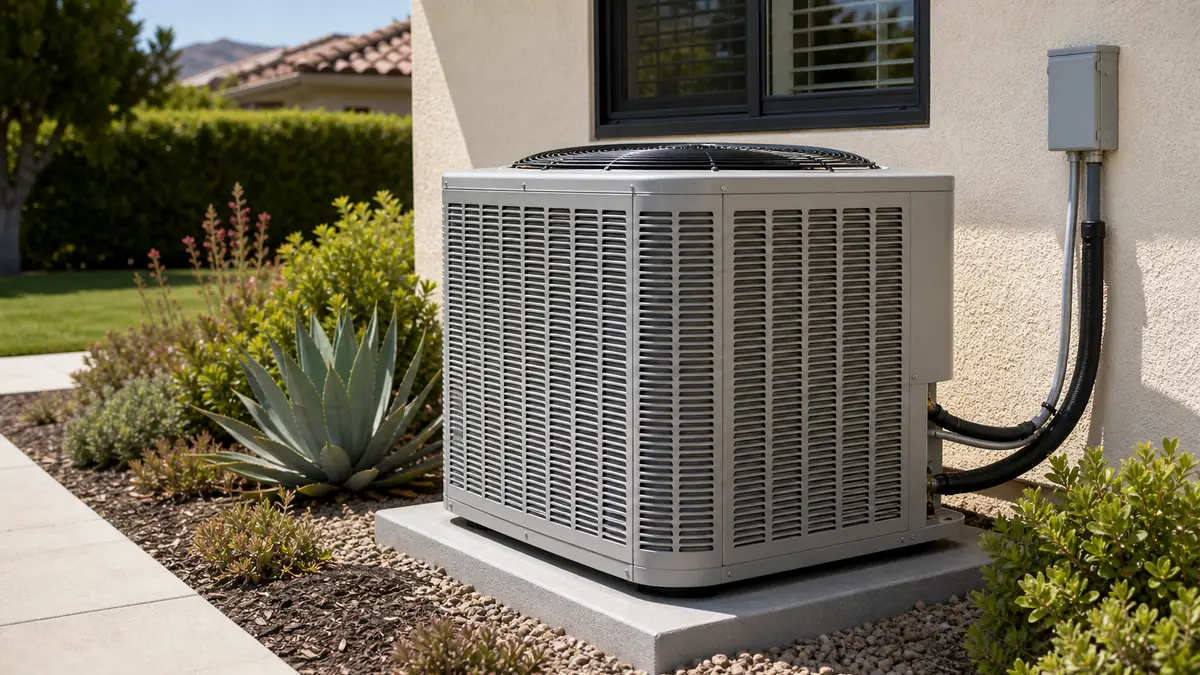
Performance is Carrier's mid tier, between value Comfort and flagship Infinity. The 26TPA8 Performance 18 is a two-stage air conditioner: it runs on a low stage most of the time and kicks to high only on the hottest part of the day. That makes it quieter and steadier than a single-stage Comfort unit while costing far less than a variable-speed Infinity. The 26SPA6 Performance 16 is the single-stage option. In the Santa Clarita Valley, the two-stage 26TPA8 is the sweet-spot upgrade for a Canyon Country or Saugus two-story that wants better comfort without the Infinity premium.
| Symptom | Likely cause / first check | Cost lane |
|---|---|---|
| Hard click/buzz, no start in heat | Weak capacitor or pitted contactor | $150-$450 |
| Outdoor fan not spinning, unit hot | Condenser fan motor or capacitor | $250-$700 |
| Cools weakly, long run times | Low refrigerant, dirty coil, or failing TXV | $225-$1,500 |
| Two-stage never reaches high stage | Thermostat staging or control wiring | $150-$500 |
| Iced indoor coil, frost on suction line | Low charge or airflow restriction; check static | $225-$1,500 |
| 27VPA9 variable unit runs flat-out | Inverter or control fault; verify before parts | $400-$2,000 |
Do I need the Infinity control for a Performance unit?
No. Performance equipment is non-communicating, so it runs on a conventional 24 V thermostat rather than the Infinity System Control. A two-stage 26TPA8 does want a two-stage-capable thermostat to use both speeds; a single-stage 26SPA6 works with any standard smart stat. That makes Performance simpler and cheaper to control than Infinity, and a good match for homeowners who want a modern smart thermostat without the communicating-system complexity.
What are the Performance series models?
Performance is the mid tier, and it spans single-stage, two-stage, and even variable-speed without the Infinity communicating requirement. The models you will find on valley homes:
- 26TPA8 (Performance 18 AC, two-stage). The flagship of the tier and the sweet-spot upgrade in Santa Clarita: low stage for most of the day, high stage only on the hottest part of a 100 F afternoon. Quieter and steadier than single-stage, well below Infinity pricing.
- 26SPA6 (Performance 16 AC, single-stage). The value Performance air conditioner for owners who want the tier's build quality without two-stage staging.
- 27TPA8 (Performance 18 heat pump, two-stage) and 27SPA6 (Performance 16 heat pump, single-stage). The heat-pump cousins, same staging plus a reversing valve and defrost control.
- 27VPA9 (Performance 19, variable-speed InteliSense). A variable-speed heat pump that delivers modulation at a mid price and does not require the full Infinity System Control, a useful middle ground.
- 26TPA8...C / 27TPA8...C Coastal. Corrosion-protected versions for salt-air exposure. Inland and dry, Santa Clarita rarely needs them; here heat and dust, not salt, are the enemies.
What goes wrong on a Performance unit in the valley?
Performance air conditioners are non-communicating, so the condenser is diagnosed electrically rather than by numeric code. The common valley failures:
- Capacitor or contactor. A hard click or buzz on startup with no start, the most frequent SoCal failure as 100 F-plus heat cooks the parts.
- Condenser fan motor. A stalled outdoor fan lets head pressure climb until the unit trips.
- Refrigerant or TXV. Weak cooling and long runs from a flare-joint leak, a dirty coil, or a failing thermostatic expansion valve.
- Staging faults. A 26TPA8 stuck on low usually points to the thermostat staging or control wiring, not the compressor, which is a cheap fix worth checking first.
- Inverter faults (27VPA9). On the variable-speed Performance unit, a control or inverter fault can drop it to single-speed; we verify the board before condemning the compressor.
Where does Performance fit a Santa Clarita home?
Performance is the default upgrade path off a dead builder Comfort unit, and it suits the valley's housing stock well. A two-story Canyon Country or Saugus tract home with a hot upstairs gains real comfort from the 26TPA8's low-stage running, which dehumidifies and evens out floors better than a single-stage unit, without the Infinity premium. Because the equipment is non-communicating, it reuses conventional thermostat wiring and pairs with an ordinary two-stage smart thermostat, so the install is simpler than a Greenspeed system. As with any tier here, we run a Manual J calc rather than copying the oversized builder tonnage, and a Zone 9 changeout still triggers the permit, charge and airflow verification, and HERS duct testing when ducts are altered.
Repair, or upgrade the Performance tier?
Capacitor and contactor jobs are routine and worth doing on any Performance unit of reasonable age. The decision point matches what we use elsewhere: when a major component fails on a unit past 10-12 years and the repair exceeds half a replacement, consider a changeout. From a Performance baseline, the natural moves are sideways to a newer two-stage or up to an Infinity Greenspeed for the valley's long runtimes. If you are coming off a dead Comfort unit, Performance is usually the most cost-effective upgrade. We size every replacement with a Manual J calc.
Common questions about Carrier Performance series
What is the difference between Performance 26TPA and 26SPA in my Canyon Country home?
The 26TPA8 is a two-stage Performance 18 that runs low most of the time and high only when needed, which is quieter and more even than a single-stage. The 26SPA6 is a single-stage Performance 16. Both are mid-tier, non-communicating units, so they work with standard two-stage or single-stage smart thermostats.
Is a Performance two-stage worth more than a Comfort single-stage in the valley?
For Santa Clarita's long cooling season, usually yes. The two-stage 26TPA8 spends most of its runtime on low speed, which dehumidifies better and keeps a two-story more even than a single-stage Comfort unit, without the price of a variable-speed Infinity. It is the common middle-ground upgrade here.
Do coastal-protected Performance units matter in Santa Clarita?
Less than at the beach. Carrier offers Coastal versions (the C suffix, like 26TPA8...C) with extra corrosion protection for salt-air exposure. Santa Clarita is inland and dry, so standard units are fine; the bigger enemy here is heat and dust, not salt.
My Performance AC is loud on startup. Is that a problem?
A hard electrical click or buzz on start often points to a weak capacitor or pitting contactor, the most common SoCal failure in the heat. A mechanical clatter can be a loose fan blade or a failing condenser fan motor bearing. We diagnose by sound, electrical test, and inspection rather than guessing.
Is the variable-speed 27VPA9 close to an Infinity Greenspeed?
It gets you most of the way. The 27VPA9 modulates for quieter, steadier comfort at a mid price, without the full Infinity communicating control. A Greenspeed unit still edges it on top-end efficiency and the touchscreen diagnostics, so the choice comes down to budget and how much the last few SEER2 points matter for your runtime, which we weigh against a Manual J load.