High HVAC Energy Bills in Santa Clarita
Quick take: High HVAC energy bills in Santa Clarita, CA, usually come from runtime waste in the valley heat. Santa Clarita Carrier HVAC traces leaky 91355 ducts, low refrigerant, dirty coils, and short-cycling Carrier units, so call (213) 566-7218 or book online for a Valencia or Saugus efficiency diagnosis.
Quick reference
- Cooling dominates valley bills: 55-75 days a year over 90 F means long runtimes.
- Leaky attic ducts can lose 20-30 percent of conditioned air into a 130-150 F attic.
- Low refrigerant, dirty coils, and clogged filters all force longer run cycles.
- Oversized single-stage units short-cycle, wasting repeated startup surges.
- Fixes range from a $0 filter swap to duct sealing ($400-$3,100) or a right-sized replacement.
- Federal 25C tax credit was repealed effective 12/31/2025; confirm any current utility rebate before relying on it.
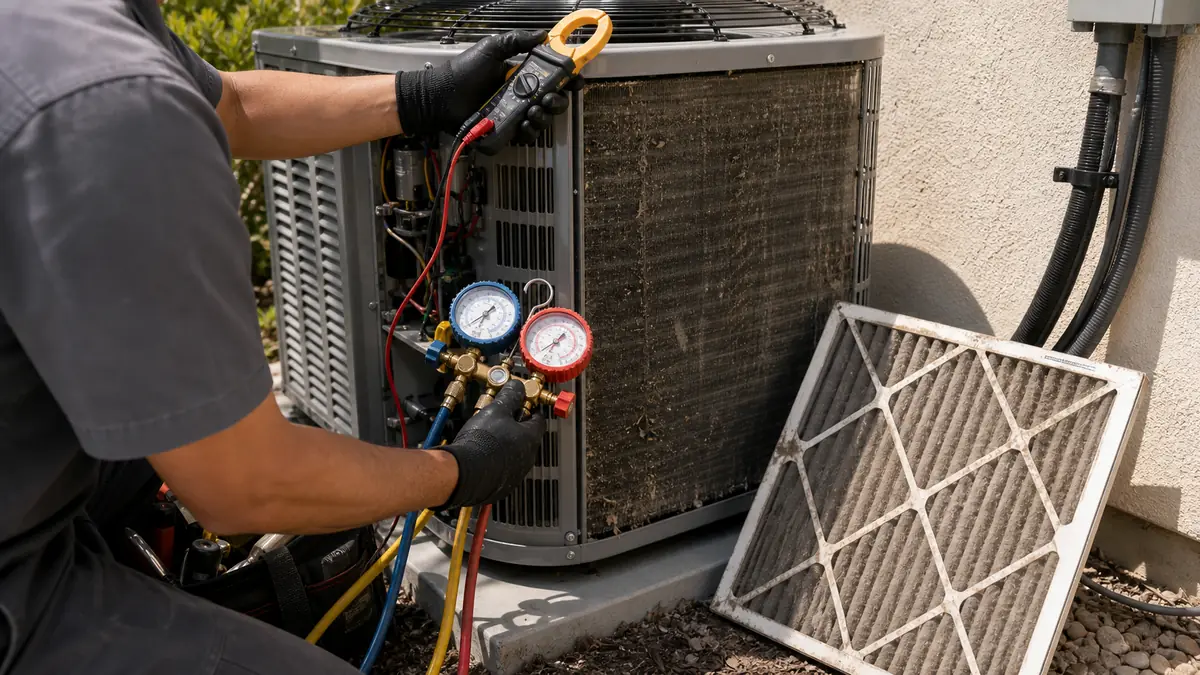
Why are HVAC bills so high in Santa Clarita?
The valley sits above the LA basin and runs hotter, so cooling is the lion's share of a summer electric bill, and any inefficiency gets multiplied across 55 to 75 hot days a year. The most common local causes are leaky attic ductwork dumping cold air where nobody lives, low refrigerant from a slow leak, a dirty evaporator coil or clogged filter forcing longer cycles, and oversized single-stage equipment that short-cycles. Each one is measurable, so we diagnose rather than guess.
| Cause | How we confirm it | Fix cost lane |
|---|---|---|
| Leaky or disconnected attic ducts | Duct-leakage test, static pressure | $400-$3,100 |
| Low refrigerant from a leak | Superheat/subcool, leak search | $225-$1,500 |
| Dirty coil or clogged filter | Inspection; Infinity code 44 | $0-$400 |
| Oversized unit short-cycling | Runtime log, Manual J load check | Right-size at replacement |
| Old low-SEER single-stage system | Compare draw vs right-sized system | $5,000-$16,000 |
What can I rule out myself first?
Replace a dirty filter, because a clogged one in valley dust forces longer cycles and starves airflow. Make sure attic access hatches and supply registers are not blocking the system from doing its job, and that the outdoor condenser coil is not packed with dust and cottonwood fluff. Set a reasonable thermostat schedule that pre-cools before the late-afternoon peak rather than fighting the heat at its worst. If the bill stays high after those, the cause is hidden in the ducts, refrigerant charge, or equipment, and that needs measurement.
When is replacement the real money-saver?
If your equipment is an aging low-efficiency single-stage Comfort unit that runs nonstop and still falls short, a right-sized higher-SEER2 replacement frequently earns its cost back through reduced runtime in this cooling-heavy valley. That payback only materializes, though, when the ducts are sealed and the unit is sized to a Manual J load instead of the old oversized tonnage. We measure your current draw against a properly sized Performance or Infinity system so the numbers are real, not hypothetical. For the efficiency rules and the current rebate picture, read the SEER2 and rebates guide; for duct losses, the duct repair page.
How do you find what is driving the bill up?
An efficiency diagnosis is a measurement job, not a guess, because every cause above is invisible until you instrument it. We start with a duct-leakage check and total external static pressure across the air handler, since leaky attic runs in a 130-to-150 F Santa Clarita attic are the single biggest hidden drain, often losing 20 to 30 percent of the cooling you paid to make. Next we read superheat and subcool to confirm the refrigerant charge, because a unit even a pound low runs longer for less cooling. We inspect the coil and filter for restriction, pull any Infinity code 44, and log runtime to spot a short-cycling oversized unit. Only with those numbers in hand do we say whether the fix is a $0 filter, sealed ducts, a leak repair, or a right-sized replacement. That order keeps you from spending $10,000 on equipment when a $600 duct seal would have done it, and it keeps us from topping off refrigerant that is just going to leak out again.
Common questions about high HVAC bills
Why is my SCE bill so high in summer in Saugus?
Santa Clarita runs 55 to 75 days a year over 90 F, so cooling dominates the bill, and any inefficiency multiplies. The usual local culprits are leaky attic ducts dumping cold air, low refrigerant making the system run longer, a dirty coil, or an oversized single-stage unit short-cycling. We measure to find which one.
Does an oversized Carrier AC actually raise my bill?
It can. A single-stage unit that is too big chills the air fast, hits the thermostat setpoint, and cuts off before pulling humidity out, then kicks back on shortly after. That short-cycling burns the energy-hungry startup surge again and again. Right-sizing with a Manual J calc, or switching to a modulating system, evens out runtime and lowers the bill.
Can low refrigerant make my electric bill climb?
Yes. A unit low on refrigerant from a slow leak cannot reach setpoint, so it runs longer and harder while cooling less, which drives up consumption and can ice the coil. We find and repair the leak rather than just topping off, because a recharge without a repair just leaks out again.
Would a high-SEER2 Carrier system lower my bills here?
In this high-cooling valley, a properly sized higher-SEER2 system usually does cut runtime cost, because it does more cooling per watt over long summer days. The savings depend on your starting equipment and ducts. We compare your current draw against a right-sized replacement so the math is real, not a sales promise.