Carrier Heat Pump Repair in Santa Clarita
Quick take: Santa Clarita Carrier HVAC repairs Carrier heat pumps across Santa Clarita, CA, from Saugus (91350) to Canyon Country (91387). We diagnose reversing valves, defrost boards, capacitors, and Infinity codes 178/179 on 27-series units, then call (213) 566-7218 or book online for $150-to-$3,500 same-week service.
Quick reference
- Covers Carrier Comfort 27SCA, Performance 27SPA/27TPA, and Infinity Greenspeed 27VNA/25VNA heat pumps.
- Common valley faults: stuck reversing valve, defrost board, capacitor, low refrigerant, 178/179 comm errors.
- Capacitor or contactor repair typically $150-$450; reversing valve work runs much higher.
- Inverter or Infinity communicating board $400-$2,000; compressor $1,200-$3,500.
- Service in Valencia, Saugus, Canyon Country, Newhall, Tesoro del Valle, Stevenson Ranch-adjacent.
- In-warranty Carrier heat pumps referred to authorized service first.
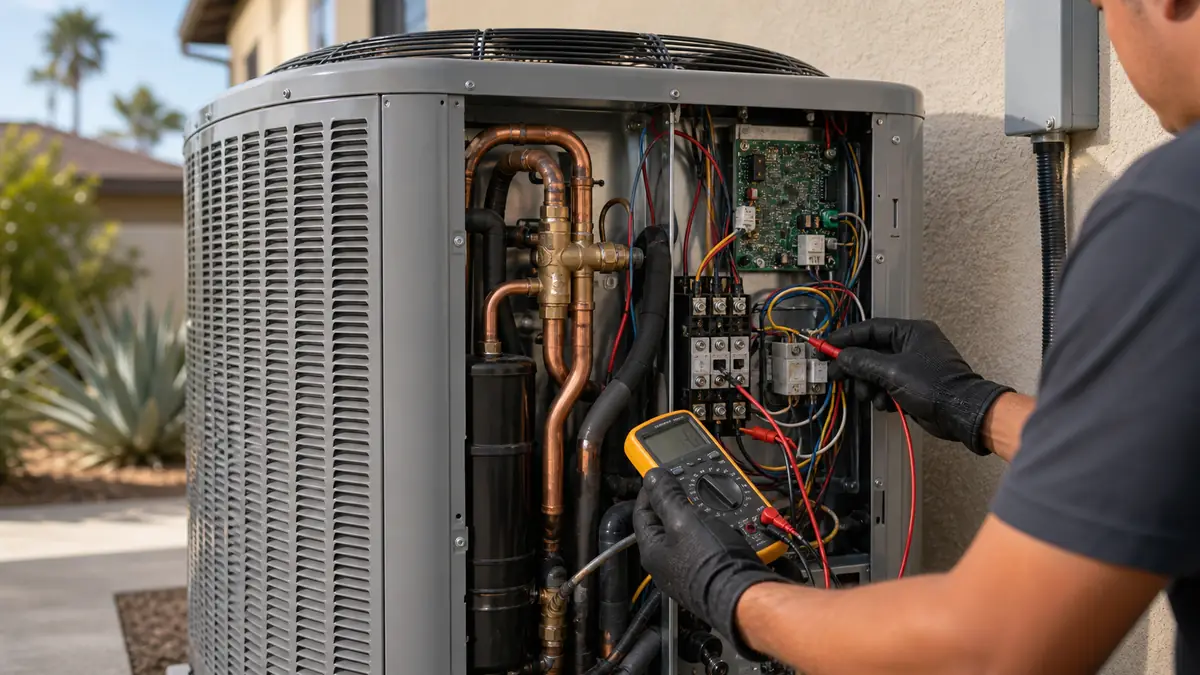
What goes wrong with Carrier heat pumps in Santa Clarita?
A heat pump in the Santa Clarita Valley spends most of the year cooling, so it wears like an air conditioner: capacitors, contactors, and condenser fan motors cook in the 100 F-plus heat. The heat-pump-specific failures show up in winter, when the unit reverses to heat. The two parts that define heat pump repair are the reversing valve, which switches refrigerant flow, and the defrost control, which clears frost off the outdoor coil. On variable-speed Infinity units, a third category appears: inverter and communication faults tied to the Greenspeed board and the Infinity System Control.
| Symptom | Likely cause / first check | Cost lane |
|---|---|---|
| Lukewarm air in heat mode, never gets warm | Stuck reversing valve or failed solenoid coil; verify with gauges | $400-$1,500 |
| Outdoor unit iced over, no defrost | Defrost control board or outdoor coil thermistor; check 56 sensor code | $250-$900 |
| Condenser hums, will not start in cooling | Dual-run capacitor or contactor; Infinity may flag 73 | $150-$450 |
| Outdoor fan dead, unit overheats and trips | Condenser fan motor or its capacitor; check 56 OAT/OCT sensor | $250-$700 |
| Weak cooling, iced indoor coil, long runs | Low refrigerant leak or restricted airflow; code 44 / 54 | $225-$1,500 |
| "Communication Fault" on the Infinity screen | ABCD comm wiring or board; codes 178 (indoor) / 179 (outdoor) | $400-$2,000 |
| Greenspeed runs single-speed, high bills | Missing or failed Infinity System Control or inverter PCB | $400-$2,000 |
How do you diagnose a Carrier reversing valve fault?
A reversing valve that hangs mid-stroke is the classic "my heat pump blows cool air" complaint. We confirm it with gauges rather than guessing: in heating, the discharge line should be hot and the suction cool, and a valve stuck between positions bleeds refrigerant across the ports so neither line reaches the right temperature. We also energize the solenoid to hear and feel it shift. On a Performance 27TPA8 or Comfort 27SCA5, replacing the valve means recovering refrigerant, brazing, and recharging by weight, so it is a real job, not a quick part swap. We always rule out a cheap solenoid coil or a control-wiring fault first.
Which Carrier heat pump models do we repair here?
Santa Clarita heat pumps span Carrier's three tiers, and the tier dictates which parts fail and how the unit reports trouble. The model number on the condenser nameplate tells us before we arrive whether we are chasing a simple capacitor or a communicating inverter fault.
- Comfort 27SCA5 (single-stage). The value tier in many 1990s and 2000s tracts. Non-communicating, so faults are diagnosed electrically; the usual repairs are capacitor, contactor, reversing valve, and defrost board.
- Performance 27SPA6 and 27TPA8. Single-stage and two-stage mid-tier units. The 27TPA8 adds two-stage staging, so a "never reaches high stage" complaint can be thermostat or control wiring rather than a compressor.
- Performance 27VPA9 (variable-speed InteliSense). A variable-speed unit that does not need the full Infinity control, so its inverter faults can appear without the 178/179 comm codes.
- Infinity Greenspeed 27VNA3 (Infinity 23), 27VNA0 (Infinity 20), and 25VNA4 (Infinity 24, up to about 22 SEER2 / 10.5 HSPF2). The flagship variable-speed line. These require the Infinity System Control and report numeric plus plain-language codes, including 178/179 comm faults and inverter alerts.
- 27VNA1 Ultimate Cold Climate. Rare in the mild valley but occasionally specified; it sustains heat output at lower outdoor temperatures than the standard Greenspeed.
How does a Carrier heat pump diagnosis go, step by step?
A heat pump is an air conditioner with a reversing valve and a defrost cycle, so the diagnosis covers the cooling side plus those two extra systems. We work a fixed order:
- Read stored codes. On Infinity, pull 178/179, 44, 54, or 56 off the touchscreen; on a non-communicating Comfort or Performance unit, diagnose electrically since there is no numeric code.
- Electrical and startup. Capacitor microfarads against the rating, contactor for pitting, and 230 V at the disconnect. A humming condenser that will not start is almost always a capacitor or contactor in this heat.
- Mode test. In heating, the discharge line should be hot and the suction cool; lukewarm air with both lines near the same temperature points to a reversing valve bleeding across its ports.
- Defrost and sensors. Force a defrost cycle and check the outdoor coil thermistor and the 56 OAT/OCT sensor when the unit ices over and never clears.
- Refrigerant side. Superheat and subcool to confirm charge, then a leak scan at the flare joints and coil if the readings are low.
- Comm and inverter (Infinity). Meter the ABCD bus voltage and line voltage before condemning any board, because a loose terminal or rodent-chewed wire mimics a costly PCB failure.
What does Carrier heat pump repair cost in Santa Clarita?
Most heat pump repairs land between $150 and $3,500, and the part dictates the lane. The common 2026 SoCal jobs:
- Capacitor or contactor: $150 to $450. The most frequent valley repair, since heat cooks these parts. Part is cheap; the cost is the trip and labor.
- Condenser fan motor: $250 to $700. A common failure on units baking on a south- or west-facing pad through summer.
- Reversing valve: $400 to $1,500. A real job, not a swap. We recover refrigerant, braze the new valve in, and recharge by weight, so it sits well above a capacitor.
- Refrigerant leak repair and recharge: $225 to $1,500. Leak search runs $100 to $330; R-410A is roughly $50 to $80 per pound installed. Flare joints are the usual leak point.
- Inverter or Infinity communicating board: $400 to $2,000. The part alone can be $120 to $800-plus, which is why we rule out wiring first.
- Compressor: $1,200 to $3,500, lower if it is still under Carrier's parts warranty and you pay labor only. On a variable-speed Greenspeed unit this sits at the high end, and at that price replacement often wins.
What do Infinity heat pump fault codes 178 and 179 mean?
Carrier's Infinity communicating systems put a numeric code and a plain-language description on the touchscreen. Code 178 is an indoor-unit communication fault between the control and the indoor board; 179 is the outdoor-unit equivalent. Both usually trace to the ABCD four-wire communication harness: a loose terminal, a wire chewed by a rodent in a Canyon Country side yard, water intrusion into the outdoor board, or lost 230 V power to the condenser. We meter the comm voltage and line voltage before condemning a board, because a $5 wiring fix saves a $1,200 PCB. Note that strings like "180" or "187" sometimes seen online are Carrier model/series numbers, not fault codes.
When should a Carrier heat pump be replaced instead of repaired?
Two quick checks settle most of these calls. Check one weighs the repair quote against a new system: if the fix runs near half a replacement's cost on a heat pump already past 10-12 years, plan the changeout. Check two is the age-times-repair figure; once it clears about $5,000, the same answer holds. By those measures a 2012 Comfort heat pump staring down a compressor is a replace, while a 2020 Infinity that only wants a capacitor is an easy repair worth keeping. Since SEER2 minimums climbed in 2023, a replacement also tends to trim runtime cost in this high-cooling-load valley. See our Carrier heat pump model guide and the Manual J sizing guide before you commit.
Common questions about Carrier heat pump repair
Why does my Carrier heat pump blow cold air in heating mode in Canyon Country?
Usually a stuck reversing valve or its solenoid, a failed defrost control, or low refrigerant. On a Performance 27TPA8 the valve can hang between cooling and heating, so air feels lukewarm. We check the valve coil, defrost board, and superheat before condemning any major part.
My Infinity heat pump shows fault 179. What does that mean?
Code 179 is an outdoor-unit communication fault: the Infinity System Control lost its conversation with the outdoor board over the ABCD wiring. We inspect for chewed or loose comm wires, water-damaged boards, and lost line voltage to the condenser, which is common after rodent activity in valley attics and side yards.
Is heat pump repair cheaper than AC repair on the same Carrier unit?
Mostly the same, because a heat pump is an air conditioner that also runs in reverse. The extra parts that can fail are the reversing valve and the defrost control. Capacitor and contactor jobs still run $150-$450; a reversing valve replacement is far more involved and can push past $1,000.
Should I repair a 14-year-old Carrier heat pump or replace it?
At 14 years, if the repair approaches half a new system's cost, replacement is usually smarter, especially with SEER2 minimums now higher. We give you both numbers in writing so you can weigh a $900 repair against a right-sized changeout for your Saugus or Valencia home.
My Carrier heat pump ices up in the morning. Is that a problem?
A light frost that clears within a defrost cycle is normal in cool, damp valley mornings. A coil that stays caked in ice means the defrost system is not working, usually a failed defrost control board, a bad outdoor coil thermistor, or low refrigerant. We force a defrost cycle and check the 56 sensor to tell which it is.
Can a power-stealing thermostat damage a Carrier heat pump board?
It can cause erratic behavior and nuisance comm faults on an Infinity system, which is why these need a properly powered Infinity System Control rather than a generic power-stealing stat. On a Comfort or Performance unit a standard 24 V thermostat with a C-wire is the reliable setup. We verify the control wiring whenever a board acts up.