Carrier Furnace Repair in Santa Clarita
Quick take: Santa Clarita Carrier HVAC repairs Carrier gas furnaces across Santa Clarita, CA, from Newhall to Valencia (91355). We read 59-series flash codes 13, 14, 31, and 34 to fix igniters, flame sensors, and inducers, then call (213) 566-7218 or book online for a $150-to-$1,200 heating diagnosis.
Quick reference
- Services Carrier 59-series condensing and 58-series 80 percent furnaces (59MN7, 59TN, 59SC, 58 family).
- Reads two-digit flash codes and Infinity plain-language fault descriptions.
- Common fixes: hot-surface igniter, flame sensor, pressure switch, inducer motor, control board.
- Typical furnace repairs run $150-$1,200; control or inverter boards reach $400-$2,000.
- Rollout (code 26) gets a heat-exchanger and combustion-safety inspection, not a reset.
- Serving Newhall, Valencia, Saugus, Canyon Country, Tesoro del Valle, Stevenson Ranch-adjacent.
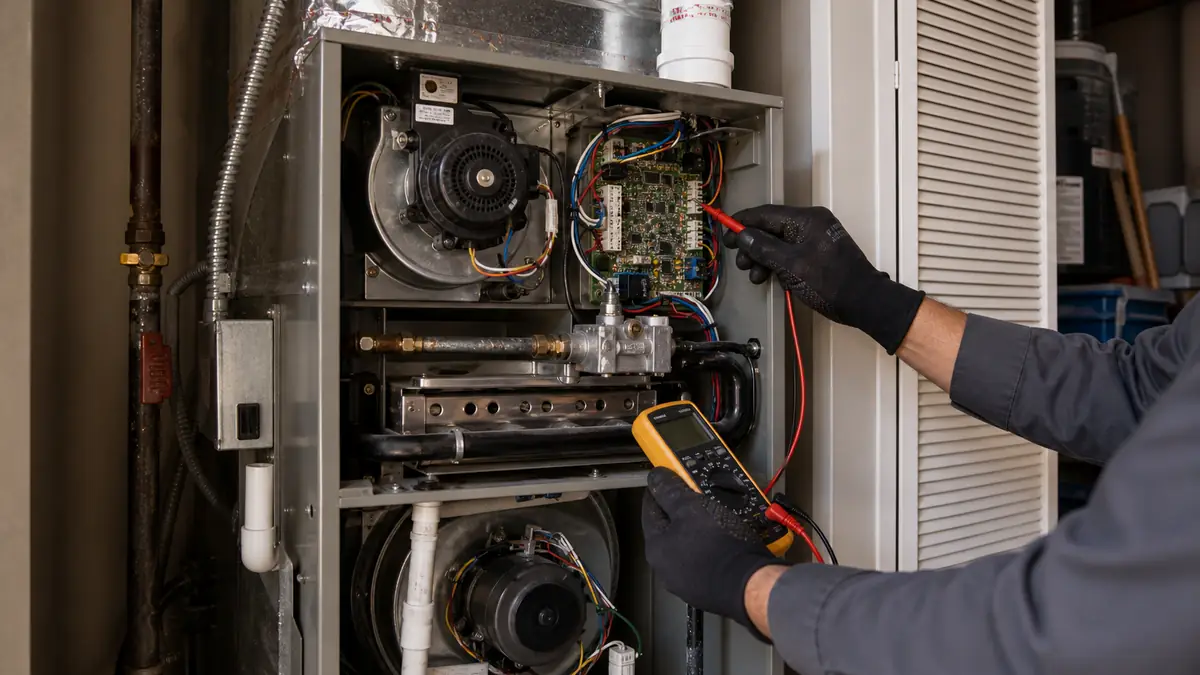
What Carrier furnace problems are common in Santa Clarita?
Furnaces here run a short, mild season, so the failures cluster at first firing each fall when a part that was fine in spring has corroded or weakened. The valley's older Newhall ranch homes and the 1990s tract furnaces share the same culprits: a flame sensor coated in oxide, a pressure switch fouled by a partially blocked flue or condensate, or a tired hot-surface igniter. Carrier's flash codes point you straight at the cause, which keeps the diagnosis honest.
| Symptom / code | Likely cause / first check | Cost lane |
|---|---|---|
| Lights then drops out, code 34 | Dirty or weak flame sensor; clean or replace | $150-$350 |
| No ignition, code 14 hard lockout | Failed hot-surface igniter or no gas/flame | $250-$600 |
| Will not start, code 31 | Pressure switch, inducer motor, or blocked flue | $200-$700 |
| Overheats and trips, codes 13 / 33 | Open high-limit from low airflow; check filter, blower, coil | $150-$600 |
| Dead board, no LED, code 24 | Open secondary-voltage (transformer) fuse or shorted accessory | $150-$400 |
| Greenspeed furnace won't talk, codes 178 / 179 | ABCD comm wiring or Infinity board; meter the bus first | $400-$2,000 |
| Shuts down, code 26 rollout | Rollout switch and heat-exchanger safety inspection | Inspect first |
How do I read a Carrier furnace flash code?
Open the furnace's lower panel and watch the amber status LED on the control board. Carrier encodes the fault as two digits: the first is a set of short flashes, the second a set of long flashes. Three short and four long reads as 34, an ignition-proving failure where the board saw flame then lost it, usually a dirty flame sensor. Code 13 is a limit lockout from overheating; 31 is a pressure-switch problem; 14 is a hard ignition lockout. On a communicating Infinity furnace, the Infinity System Control shows the same number plus a plain-language description, which is the easiest way to confirm before we arrive.
Which Carrier furnace models do we service in the valley?
Santa Clarita gas furnaces fall into Carrier's 59-series condensing and 58-series 80 percent families, and the tier changes both the repair and the diagnostics. Knowing your model number tells us whether to expect a simple board with a flashing LED or a communicating Infinity furnace that reports plain-language faults.
- Infinity 59MN7 (Infinity 98). Modulating gas valve plus a variable-speed ECM blower, around 98 AFUE. It reports faults on the Infinity System Control screen and unlocks staging only when the ABCD bus is healthy. Repairs here can involve the modulating valve or the ECM module, which sits at the high end of the cost band.
- Infinity 59TN7 / 59TN6 (Infinity 97 / 96). Two-stage, variable-speed ECM. Common in mid-2000s and newer Valencia and Tesoro del Valle homes that wanted quiet, even heat.
- Performance 59TP6 and Comfort 59SC6. Single- and two-stage 96 percent condensing furnaces with a standard control board and an amber flash-code LED, the workhorse tier in 1990s and 2000s Saugus and Canyon Country tracts.
- 59CU5 / 59SU5 Ultra-Low NOx. California emissions-rule variants. When one of these needs replacing, the swap must stay Ultra-Low NOx to meet local air-district rules.
- 58-series 80 percent (58TP, 58SC). Non-condensing budget furnaces still common in older Newhall stock, where the mild winter never justified a condensing upgrade.
How does a Carrier furnace repair actually go?
A heating no-start follows a fixed diagnostic order so we are not throwing parts at the board. Carrier's ignition sequence is the same across the 59 and 58 families, so we walk it step by step:
- Pull the code. Count the amber LED flashes (short digit, long digit) or read the Infinity screen. A stored 34, 31, or 14 narrows the search before we open anything.
- Watch a full call for heat. The inducer should spin up, the pressure switch close, the hot-surface igniter glow, the gas valve open, and the flame sensor prove flame within a few seconds. Where the sequence stalls names the part.
- Test the suspect component. Microamp draw on the flame sensor (a weak signal causes code 34), continuity and resistance on the igniter, pressure-switch closure against the inducer vacuum, and 24 V at the gas valve.
- Check airflow and safeties. A dirty filter or blocked return trips the high-limit (codes 13/33), so we verify static and inspect the limit and rollout switches before any reset.
- Replace and re-fire. Swap the failed part, run two or three full ignition cycles, confirm the flame signal is solid, and verify the code clears, with a combustion check on anything that touched the burner area.
What does Carrier furnace repair cost in Santa Clarita, and why?
A heating repair here usually lands between $150 and $1,200, with the spread driven by the part, not the brand. Here is how the common jobs break down in 2026 SoCal pricing:
- Flame sensor clean or replace (code 34): $150 to $350. The part is cheap; most of the cost is the trip and the diagnosis. The most common fall no-heat call.
- Hot-surface igniter (code 14): $250 to $600. A brittle igniter that finally cracks at first firing. Moderate part cost plus labor.
- Pressure switch or inducer (code 31): $200 to $700. A switch is inexpensive; a full inducer motor pushes the high end.
- Control board: $400 to $700, or $400 to $2,000 for an Infinity communicating board. Standard 59SC/59TP boards are mid-range; the Infinity 59MN7 board sits high.
- Diagnostic visit: about $79 to $200, often credited toward an approved repair. The valley's short heating season means many of these calls are a single inexpensive part at first firing, not a major job.
When is a furnace code a safety issue?
Most codes are nuisance faults, but a few are not. Code 26 is a rollout-switch trip: flame or heat is escaping the burner area, which can mean a cracked heat exchanger. We do not simply reset that. We inspect the heat exchanger and test for combustion spillage, because a compromised exchanger can leak carbon monoxide into the home. The same caution applies to repeated limit lockouts (13 and 33) that point at a chronic airflow restriction. If your furnace shows a rollout fault, shut it off and call (213) 566-7218.
Repair or replace a Carrier furnace in the valley?
Because the heating season is short, a sound furnace is usually worth repairing well past the age where you would replace an air conditioner. The exception is a cracked heat exchanger or a unit failing alongside a dead AC, where a combined changeout makes sense. Many valley homes run a single-stage 96 percent or California Ultra-Low NOx 59SC-class furnace perfectly well; modulating 59MN7 units only pay off with longer runtimes. If you are also replacing cooling, weigh a heat pump conversion against a new gas furnace.
Common questions about Carrier furnace repair
My Carrier furnace flashes a code on the control board. How do I read it?
Carrier 59-series boards flash a two-digit code: count the short flashes for the first digit and long flashes for the second. So three short plus four long is code 34, an ignition-proving failure. Infinity systems also show the number and a plain-language note on the touchscreen. Tell us the code when you call and we arrive with the likely part.
Why does my furnace start then shut off after a minute in Newhall?
That short-cycle pattern usually points to a dirty flame sensor (code 34), a marginal pressure switch (code 31), or a tripping high-limit from low airflow (codes 13 and 33). A flame sensor clean or replacement is cheap; a recurring limit trip means we check the filter, blower, and coil for a real airflow restriction.
Is it safe to keep running a furnace showing a rollout code?
No. Carrier code 26 is a rollout-switch trip, which can signal a cracked or overheating heat exchanger and a combustion-safety issue. Shut the furnace off and call us. We inspect the heat exchanger before any reset, because that is a carbon-monoxide risk, not a nuisance code.
Do Santa Clarita homes really need a high-efficiency furnace?
Not always. Winters here are mild, so many valley homes run an 80 percent or 96 percent single-stage unit just fine, and California Ultra-Low NOx models are common to meet emissions rules. We size and recommend based on your runtime, not a blanket upsell to a modulating 59MN7.
How long does a Carrier furnace last in Santa Clarita?
Often 18 to 25 years here, longer than in cold climates, because the heating season is short and the furnace logs few run-hours. The blower works hard all summer when paired with cooling, but the burner and heat exchanger see light winter duty, so a well-maintained 59-series unit commonly outlives the air conditioner it was installed with.
Why does my furnace smell like dust the first time I run it each fall?
That is dust burning off the heat exchanger and burners after months idle, and it usually clears within an hour. A persistent acrid or sulfur smell is different and worth a call, since it can signal a combustion or gas issue. We check the heat exchanger and combustion if any odor lingers past the first cycle.