SEER2 Rules and HVAC Rebates in Santa Clarita
Quick take: Santa Clarita Carrier HVAC guides Valencia (91355) and Saugus homeowners through Climate Zone 9 SEER2 minimums, Title 24 rules, and the SCE, SoCalGas, and TECH rebate landscape on Carrier equipment, so call (213) 566-7218 or book online. A new split AC must reach 14.3 SEER2 here, and the federal 25C credit ended December 31, 2025. Last updated June 14, 2026.
Quick reference
- SEER2 replaced SEER on January 1, 2023, with testing run under more realistic static-pressure conditions.
- California's place in the DOE Southwest region puts it under the nation's strictest cooling requirement.
- Split AC under 45,000 BTU: minimum of 14.3 SEER2 / 11.7 EER2.
- Split AC of 45,000 BTU or more: minimum of 13.8 SEER2 / 11.2 EER2.
- Split air-source heat pump: minimum of 14.3 SEER2 with 7.5 HSPF2 (national).
- The federal 25C credit ended on 12/31/2025; installs in 2026 receive no federal credit.
- Title 24 work in Zone 9 requires permits, charge and airflow verification, and HERS duct testing.
What is SEER2 and why did the rules change?
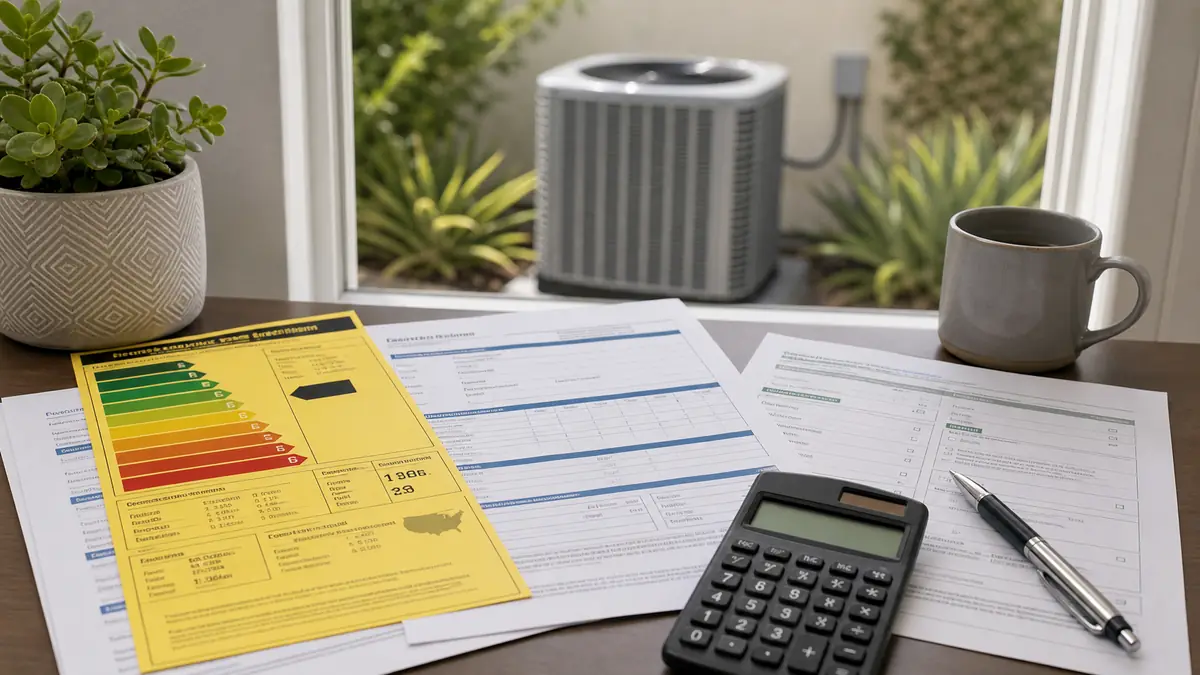
SEER2 became the efficiency benchmark for central air conditioners and heat pumps on January 1, 2023, succeeding the earlier SEER metric. The added "2" carries real weight: the updated test drives equipment against higher external static pressure, which more closely matches what a system actually encounters once connected to real ductwork. The practical effect is that identical hardware now reads a few points lower under SEER2 than it did under SEER, and the required efficiency minimum was raised at the same time. For any Santa Clarita homeowner shopping a replacement, the rule is simple: compare SEER2 to SEER2, never to an outdated SEER spec sheet, or the comparison will mislead you.
California belongs to the DOE's Southwest region, the one with the country's most demanding cooling-efficiency requirement, precisely because cities like Santa Clarita run so hot. That is why the minimums listed below sit above what a homeowner in a mild coastal or northern community would face. The Climate Zone 9 designation reinforces it: the valley is cooling-dominant, so state and federal rules both press hard on cooling efficiency and, increasingly, on heat pumps.
What are the SEER2 minimums for a Santa Clarita install?
Listed below are the current federal Southwest-region minimums for split systems, the configuration found in nearly every valley tract home. Read them as the legal baseline rather than a target; many Carrier units exceed them comfortably. Before you commit, verify the exact figure for your equipment class against the code cycle in force, because the standards and their verification triggers do change over time.
| Equipment | Minimum SEER2 | Other minimum |
|---|---|---|
| Central AC, under 45,000 BTU | 14.3 SEER2 | 11.7 EER2 |
| Central AC, 45,000 BTU and over | 13.8 SEER2 | 11.2 EER2 |
| Air-source heat pump (split) | 14.3 SEER2 | 7.5 HSPF2 |
Where do Carrier units land against this? A value Comfort 26SCA clears the floor; a two-stage Performance 26TPA8 sits well above it; and an Infinity Greenspeed 24VNA6 reaches up around 26 SEER on its top configurations, with the 25VNA4 heat pump near 22 SEER2 and 10.5 HSPF2. In a high-runtime valley, the gap between minimum and high efficiency translates into real summer-bill differences, but only on a system that is sized and ducted correctly.
What does Title 24 require in Climate Zone 9?
On top of the federal equipment minimums, it is California's Title 24, Part 6 energy code that governs how a system is installed and altered. Santa Clarita lands in Climate Zone 9, one of 16 zones tied to reference weather stations rather than city limits, which is why every install here is bound to the cooling-focused provisions. In practice, replacing a central AC or heat pump generally requires a permit, refrigerant-charge and airflow verification on the new equipment, and duct-leakage testing performed by a certified HERS rater whenever a substantial portion of the ductwork is replaced or modified. The code has also been steering toward heat-pump-ready and heat-pump-preferred baselines, which is why a gas-to-heat-pump conversion increasingly turns out to be the easier path to compliance. We pull the permit ourselves on every install and arrange the HERS verification, since an unpermitted system can complicate a future sale and void your rebates.
Which rebates can a Santa Clarita homeowner actually use?
This is the section where candor saves you money. Rebate programs change often, run in funding cycles, and a number of them were reported exhausted or paused in early 2026. Before you count on any figure, open the official program page and verify the current amount and funding status. With that caution noted, here is the lay of the land across the Santa Clarita Valley, where Southern California Edison powers most homes and SoCalGas provides the gas.
| Program | What it has covered | Status caveat |
|---|---|---|
| SCE building electrification | Heat-pump HVAC replacing gas/propane, reported around $1,000 per system | Confirm the current amount and eligibility at sce.com |
| SoCalGas HEER | High-efficiency gas furnaces (92%+ AFUE) up to ~$600; smart thermostats up to ~$50 | Figures vary by program year; check socalgas.com |
| TECH Clean California | Heat-pump HVAC incentives, market-rate ~$1,000-$1,500; HEEHRA income-qualified higher | Single-family funds reported fully reserved early 2026 (waitlist) |
| LADWP heat pump rebate | Up to a per-ton amount on qualifying heat pumps | Covers LADWP electric customers; most of Santa Clarita is SCE |
| Federal 25C tax credit | 30% of project cost, capped at $2,000/yr for heat pumps | Repealed effective 12/31/2025; unavailable for 2026 installs |
Two cautions worth flagging for valley homeowners. First, the LADWP rebate is a strong one, but it is limited to LADWP electric customers, and the bulk of Santa Clarita falls within SCE territory, so do not assume the LADWP per-ton figure applies to your address; verify which utility serves you. Second, disregard Bay Area programs such as BayREN and tri-county ones such as 3C-REN, which cover Ventura, Santa Barbara, and San Luis Obispo counties, because neither reaches Los Angeles County. We field that mix-up from homeowners all the time.
How should I plan a Carrier replacement around these rules?
Start with sizing, because efficiency ratings and rebate dollars mean nothing on a system that does not fit the house. Ahead of naming a SEER2 tier, we perform a Manual J load calculation (see the sizing guide) and measure duct static, since an oversized high-SEER2 unit short-cycles and throws away the very efficiency you paid for. Then weigh gas against a heat pump: with the federal credit no longer available, the case for a heat pump conversion now rests on utility incentives, Title 24's heat-pump-preferred direction, and the valley's heavy cooling demand. Finally, fold the permit and HERS testing into both the timeline and the budget. We handle that paperwork for you, verify charge and airflow, and seal ducts to the standard so the job passes and any live rebate stays valid.
A worked example: does higher SEER2 pay off in the valley?
Numbers make this concrete. Take a Valencia two-story that cools hard from May through September, with a system running roughly 1,800 cooling hours a year in Zone 9. Compare a baseline 14.3 SEER2 Comfort unit against a high-efficiency 24VNA6 Infinity reaching up around 26 SEER on its top configuration. SEER2 is cooling output divided by watt-hours, so a unit about 1.7 times more efficient does the same cooling for roughly that fraction of the energy on the cooling portion of the bill. On a home spending, say, $1,500 a year on summer cooling, trimming the cooling energy by a third to a half is in the $400-to-$700-a-year range, before any rebate.
The honest caveat: that gap only materializes on a system sized and ducted correctly. Bolt a high-SEER2 condenser onto leaky attic ducts and an oversized tonnage, and it short-cycles and throws the efficiency away, which is why we run a Manual J and a duct check first. The premium for the high-efficiency tier is real money up front, so the payback math depends on how many years you will own the home and how heavy your runtime is. We run your actual numbers rather than quoting a brochure percentage.
Gas furnace or heat pump for a Santa Clarita replacement?
With the federal 25C credit gone for 2026, the heat-pump case now rests on three things, and we weigh them honestly for your house. First, the valley is cooling-dominant, so a heat pump's heating side runs only a short, mild winter, meaning a Carrier 27-series heat pump spends most of the year doing the cooling work it excels at. Second, Title 24 has been steering toward heat-pump-preferred baselines, so an all-electric conversion can be the smoother compliance path on a major alteration. Third, utility incentives from SCE and TECH have historically favored heat pumps over gas, though both were reported tight or paused in early 2026, so verify before banking on a figure. Against that, a Carrier 59-series condensing gas furnace is still a sound, lower-first-cost choice for a like-for-like furnace swap where the home keeps its existing AC. There is no universal answer; there is the answer for your equipment, your ducts, and your timeline, which is what we put in writing.
Common questions about SEER2 and rebates in Santa Clarita
What SEER2 does a new AC need in Santa Clarita?
Santa Clarita sits inside the DOE Southwest region, and that region carries the strictest cooling thresholds in the country, so the requirement runs higher here than most places. A split central AC under 45,000 BTU is required to reach 14.3 SEER2 (11.7 EER2); once you cross 45,000 BTU, the requirement relaxes slightly to 13.8 SEER2 (11.2 EER2). A split heat pump is held to 14.3 SEER2 alongside 7.5 HSPF2 as the baseline. We recommend confirming the current value for your exact equipment class before signing off on a purchase.
Can I still get the federal heat pump tax credit in 2026?
No. The federal 25C Energy Efficient Home Improvement Credit was repealed effective December 31, 2025. The credit reaches only equipment that was both bought and installed by that date, and it is claimed on your 2025 return. Because nothing put in during 2026 qualifies for 25C, we recommend keeping it out of your budget entirely.
Which utility rebates apply in Santa Clarita?
For most valley addresses, electricity is delivered by SCE and gas by SoCalGas rather than LADWP, so the logical starting points are SCE's building-electrification programs and SoCalGas HEER. Layered on top, the statewide TECH Clean California program has historically funded heat-pump incentives. Several of these funds were reported fully reserved or paused as of early 2026, so we advise verifying the current status before you rely on any specific amount.
Is a higher-SEER2 system worth it in the valley heat?
Out here in cooling-dominant Zone 9, where the system grinds through long summer days, a correctly sized higher-SEER2 unit tends to recoup its cost sooner than the same unit would near the coast, simply because it squeezes more cooling out of every watt across all those hot hours. How much you save hinges on your ductwork and sizing, so we run the numbers for your house instead of quoting a one-size-fits-all percentage.
Do rebates require permits and HERS testing?
In most cases, yes. The majority of utility and state programs release funds only on a code-compliant, permitted installation, and within Climate Zone 9 that means refrigerant-charge and airflow verification together with HERS duct testing whenever the ducts are disturbed. An unpermitted job can cost you the rebate and create resale headaches later.