Carrier AC Repair in Santa Clarita
Quick take: Santa Clarita Carrier HVAC repairs Carrier air conditioners across Santa Clarita, CA, from Saugus (91350) to Canyon Country (91387). We fix no-cool 26SCA, 26TPA, and 24VNA condensers, read Infinity codes 44/54/73, and recharge R-410A, then call (213) 566-7218 or book online for $150-to-$3,500 same-week cooling service.
Quick reference
- Repairs Carrier Comfort 26SCA, Performance 26SPA/26TPA, and Infinity 24VNA6/26VNA1 air conditioners.
- Top valley no-cool causes: heat-cooked capacitor, contactor, condenser fan motor, refrigerant leak, dirty coil.
- Capacitor or contactor repair typically $150-$450; refrigerant leak repair $225-$1,500.
- Condenser fan motor $250-$700; Infinity inverter/comm board $400-$2,000; compressor $1,200-$3,500.
- No-cool calls triaged first in cooling season; same-week service across all six ZIPs.
- In-warranty Carrier units referred to authorized service first; we source genuine parts after.
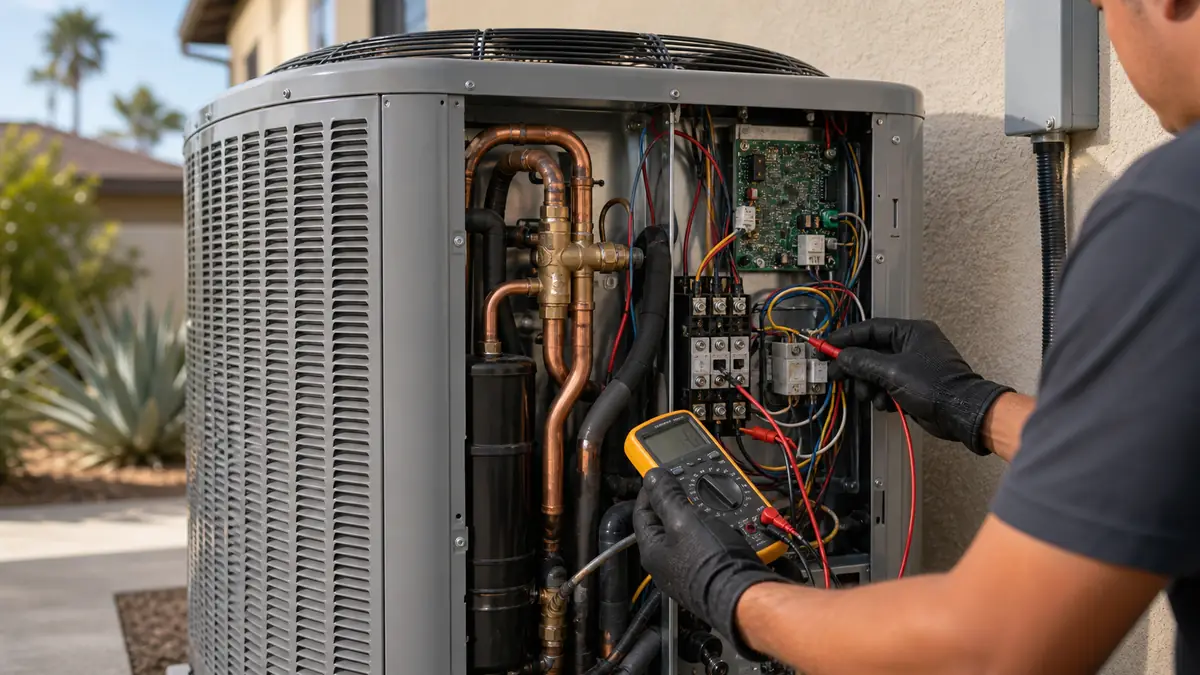
Why do Carrier ACs fail in the Santa Clarita heat?
Santa Clarita sits above the LA basin in Title 24 Climate Zone 9, where July highs run 93 to 97 F and the valley logs 55 to 75 days a year at or above 90 F, with frequent 100 F-plus Santa Ana spikes. That is one of the heaviest cooling loads in the LA metro, and it punishes the outdoor side of a Carrier condenser. The single most common no-cool call we run is a heat-cooked dual-run capacitor, followed by refrigerant leaks at flare joints and condenser fan motors that have baked on a south- or west-facing pad through a decade of summers. A 26SCA or 26TPA condenser running near-continuous on a 104 F afternoon simply wears its electrical and refrigerant components faster than the same unit would on the coast.
| Symptom | Likely cause / first check | Cost lane |
|---|---|---|
| Condenser hums, fan or compressor dead in the heat | Dual-run capacitor or pitted contactor; Infinity may flag 73 | $150-$450 |
| Outdoor fan stalled, unit overheats and trips on high pressure | Condenser fan motor or its capacitor; check 56 OCT sensor | $250-$700 |
| Runs but blows warm, weak cooling, long runs | Low refrigerant leak, dirty condenser coil, or failing TXV/EEV | $225-$1,500 |
| Indoor coil iced into a block, no airflow | Low charge or restricted airflow; code 44 on Infinity | $225-$1,500 |
| Breaker trips when the AC starts | Shorted compressor, grounded fan motor, or weak start components | $200-$1,200 |
| "Communication Fault" on the Infinity touchscreen | ABCD comm wiring or board; codes 178 (indoor) / 179 (outdoor) | $400-$2,000 |
| Variable-speed Greenspeed AC runs flat-out, high bills | Lost Infinity control or inverter PCB fault; verify before parts | $400-$2,000 |
How does a Carrier no-cool diagnosis go, step by step?
On a Santa Clarita no-cool call we hold to one diagnostic sequence every time, because letting the test order drive the work is what keeps your invoice tied to the part that actually failed instead of a hunch, and it stops us from charging a system that is only going to bleed the refrigerant back out within a season. The sequence runs like this:
- Read the system first. On an Infinity 24VNA6 or 26VNA1 we pull stored codes (44 airflow, 54 suction sensor, 56 OAT/OCT, 73 contactor context, 178/179 comm) off the touchscreen. A non-communicating Comfort 26SCA or Performance 26TPA throws no numeric code, so it is diagnosed electrically.
- Electrical and startup. Capacitor microfarads against the nameplate rating, contactor contacts for pitting, and 230 V at the disconnect. A humming condenser that will not start in this heat is almost always a swollen capacitor or a burned contactor.
- Airflow and static. Total external static pressure across the air handler and coil, plus a filter and return check, because a starved return mimics a refrigerant problem and inflates the repair. An iced coil gets thawed before any reading is trusted.
- Refrigerant side. Superheat and subcool on the gauges confirm the charge; readings low and a high superheat point to a leak, and we scan the flare joints and evaporator coil with an electronic detector before adding a pound.
- Find and fix, then verify. Repair the failed part, reseal or replace the leaking joint, weigh in the exact R-410A charge by the nameplate, then watch a full cooling cycle hold steady supply temperatures with the fault log clear.
Which Carrier AC models do we repair here?
Santa Clarita air conditioners span Carrier's three cooling tiers, and the tier dictates which parts fail and how the unit reports trouble. The model number on the condenser nameplate tells us before we arrive whether we are chasing a simple capacitor or a communicating inverter fault.
- Comfort 26SCA5 (16-class) and 26SCA4 (14-class) single-stage. The value tier in most 1990s and 2000s tracts. Non-communicating, so faults are diagnosed electrically; the usual repairs are capacitor, contactor, condenser fan motor, and refrigerant.
- Performance 26SPA6 single-stage and 26TPA8 two-stage. Mid-tier units. A 26TPA8 stuck on low stage usually points to thermostat staging or control wiring, not the compressor, which is a cheap fix worth ruling out first.
- Infinity 24VNA6 (Infinity 26) and 26VNA1 (Infinity 21) variable-speed Greenspeed AC. The flagship line. These require the Infinity System Control and report numeric plus plain-language codes, including 178/179 comm faults and inverter alerts. A Greenspeed unit that drops to single-speed has usually lost its control or thrown a comm fault.
- Older 24ABB/24ACB and R-22 condensers. Many pre-2010 valley units still run, but R-22 is phased out and costly, so a leak on one of these often tips the math toward replacement rather than a recharge.
- New R-454B (Puron Advance) systems. Carrier's 2025-onward condensers run the low-GWP A2L refrigerant, which we recover and charge with the correct equipment; the diagnostic logic is the same, but the refrigerant handling differs.
What do Carrier AC fault codes 44, 54, and 73 mean?
Only the communicating Infinity tier throws numeric AC codes; Comfort and Performance condensers are diagnosed electrically. On a 24VNA6 or 26VNA1 the codes that point at a cooling problem are worth knowing before we arrive. Code 44 is an excessive air-delivery restriction, the system flagging a dirty filter or leaky, undersized ducts before it ices the coil, so a 44 sends us to airflow, not refrigerant. Code 54 is a suction-temperature sensor out of range, and 56 is the OAT/OCT outdoor thermistor, both inexpensive sensor swaps that prevent bad staging. Code 73 means voltage is present at the run capacitor with no compressor engagement, which is a contactor, relay, or wiring context rather than a dead compressor. Strings like 180 or 187 seen in some online lists are Carrier model or series numbers, not fault codes; the genuine comm faults are 178 and 179.
What does Carrier AC repair cost in Santa Clarita, and why?
Cost tracks the failed component, not the symptom, and most cooling repairs land between $150 and $3,500. The diagnostic runs about $79 to $200 and is usually credited toward an approved repair. The common 2026 SoCal jobs:
- Capacitor or contactor: $150 to $450. The single most frequent valley failure, because the heat cooks these parts. The part itself is $10 to $45; the cost is the trip and the labor.
- Condenser fan motor: $250 to $700. A common failure on a unit baking on a south- or west-facing pad through summer. A stalled fan lets head pressure climb until the unit trips.
- Refrigerant leak repair and recharge: $225 to $1,500. Leak search runs $100 to $330; R-410A is roughly $50 to $80 per pound installed. A flare reseal is cheap, an evaporator coil leak is not.
- Inverter or Infinity communicating board: $400 to $2,000. The part alone can be $120 to $800-plus on a 24VNA6, which is why we rule out comm wiring before condemning a board.
- Compressor: $1,200 to $3,500, lower if it is still under Carrier's parts warranty and you pay labor only. On a variable-speed Greenspeed condenser this sits at the high end, and at that price a replacement often wins.
What is different about AC repairs in valley housing?
Santa Clarita's housing stock shapes almost every cooling call. The 1985-2005 master-planned boom across Valencia, Saugus, Canyon Country, and Tesoro del Valle fitted wall-to-wall builder-grade Carrier and Bryant equipment that is now hitting first-system-failure age all at once, so we see clusters of dead capacitors and aging compressors during the same heat waves. Two-story tract homes run flexible duct through attics that hit 130 to 150 F in July, so a "weak cooling upstairs" complaint is frequently 20-to-30-percent duct loss rather than a low charge, and we measure static before we touch the refrigerant. Builders also routinely set 4 tons where a Manual J load lands nearer 3 to 3.5, so an oversized condenser short-cycles, never dehumidifies, and wears its contactor faster, which is one more reason we read the whole system before swapping a single part.
When should a Carrier AC be replaced instead of repaired?
We hand homeowners two plain yardsticks so the call stays honest. The first: once a repair quote climbs to about half of what a new system costs and the condenser has already cleared 10 to 12 years, lean toward replacement. The second: multiply the unit's age by the repair price, and if the answer tops roughly $5,000, the same. A 1999 Valencia Summit Comfort condenser facing a compressor fails both yardsticks and is probably still on R-22 besides; a 2020 Performance 26TPA8 needing only a $300 capacitor clears both comfortably and is worth fixing. Since SEER2 minimums climbed in 2023, a replacement also trims runtime cost in this heavy-cooling valley. See our Carrier AC installation page for changeout detail and the Manual J sizing guide before you commit.
Common questions about Carrier AC repair
My Carrier AC is running but not cooling on a 104 F Saugus afternoon. What is wrong?
Most often low refrigerant from a flare-joint leak, a dirty condenser coil shedding heat poorly, or a failing capacitor that lets the compressor lag. On an Infinity unit a code 44 flags an airflow restriction first. We check superheat and subcool, clamp the compressor amps, and inspect the coil before topping off any R-410A.
How fast can you reach a no-cool call in Santa Clarita during a heat wave?
Same-week is normal across the 91350 to 91390 ZIPs, and we triage total no-cool failures ahead of routine work because an attic-furnace two-story in Canyon Country can pass 90 F indoors within hours. Call (213) 566-7218 with your ZIP and the model number off the condenser nameplate and we route the nearest tech.
What does Infinity fault code 73 mean on my Carrier condenser?
Code 73 means the Infinity control senses voltage at the run capacitor but the compressor is not being called or is not engaging, usually a contactor, relay, or low-voltage wiring fault rather than a dead compressor. We meter the contactor pull-in and the 24 V signal first, which keeps a $200 fix from being mis-sold as a compressor.
Is my Santa Clarita AC low on Freon, and can you just add more?
A sealed system does not consume refrigerant, so if your 26-series Carrier unit is low, it has a leak, usually at a flare joint or the evaporator coil. We find and repair the leak, then weigh in the correct R-410A charge rather than just topping off, because a recharge without a repair leaks back out within a season and ices the coil again.
Should I repair a 1998 builder-grade Carrier condenser or replace it?
If a 1998 unit on R-22 or early R-410A needs a compressor near $1,800, replacement almost always wins, since SEER2 minimums are higher and parts for a 25-year-old condenser are scarce. A capacitor or contactor on that same unit is a sensible $150 to $450 fix. We hand you both numbers in writing before you decide.
Why does my Carrier AC freeze into a block of ice in summer?
An iced indoor coil in cooling season means heat is not reaching the refrigerant, almost always low charge from a leak or restricted airflow from a clogged filter or leaky return. We thaw it fully, then read static pressure and superheat to tell airflow from charge, because recharging an airflow-starved coil just freezes it again.